
How Can Survey Logic Make Online Surveys More Relevant?
Admin | Published on: Sep 23, 2026
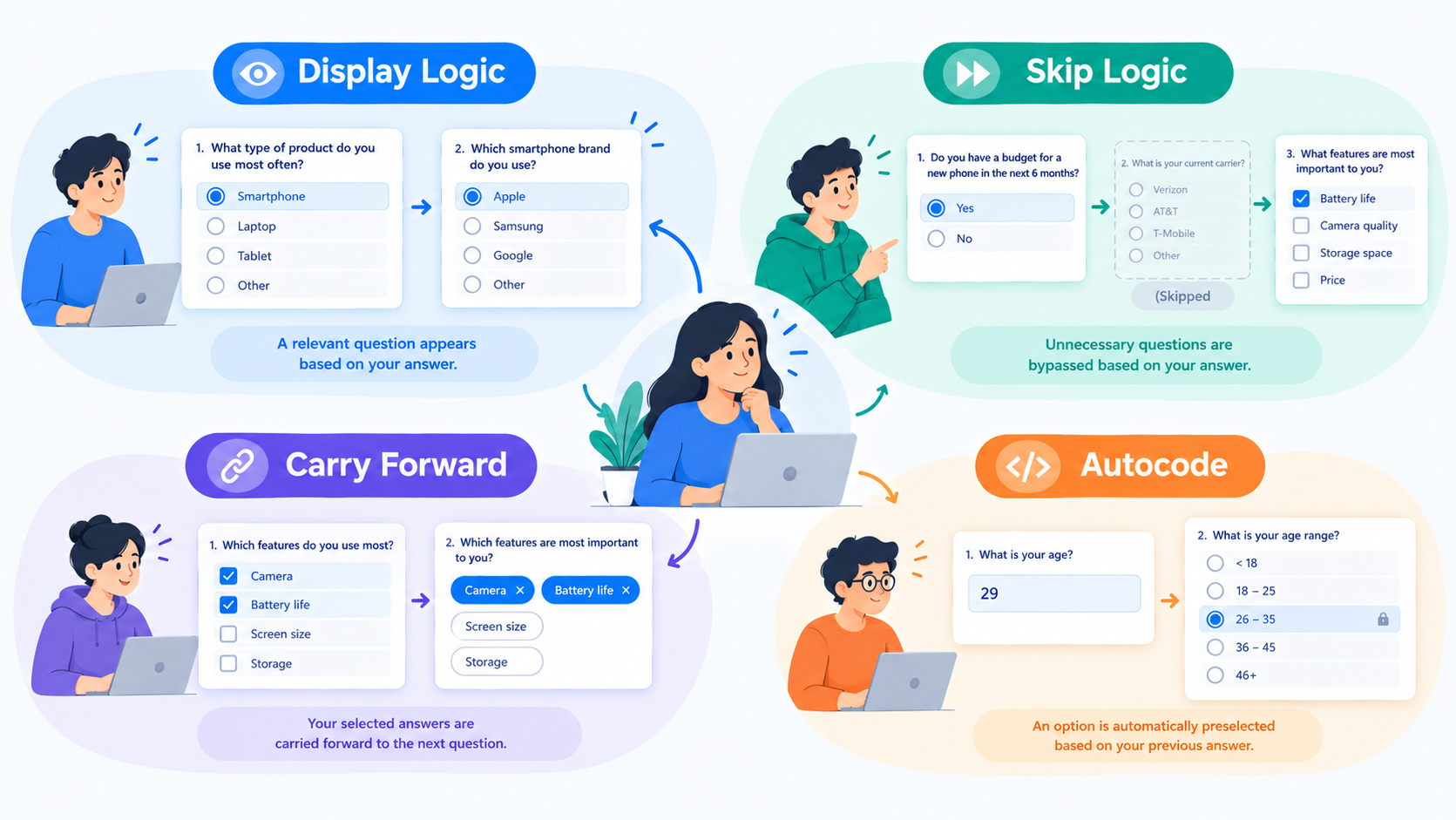
Smart survey logic helps respondents see only what matters to them. Display Logic, Skip Logic, Carry Forward, and Auto Code work together to create more relevant, structured, and efficient questionnaires
What Is Survey Logic?
Survey logic is a set of rules that changes a questionnaire based on a respondent's answers. Instead of giving every respondent the same sequence of questions, researchers can create different paths based on their responses.
This is particularly useful for market research, customer feedback, product studies, and other surveys where respondents may have different experiences or requirements.
Display Logic: Show Only Relevant Questions
Display Logic controls whether a question or option appears based on a previous response.
For example, if a respondent says they have used a particular product, you can display follow-up questions about that product. Respondents who have not used it can simply skip those questions.
This keeps the questionnaire relevant and avoids unnecessary questions.
Skip Logic: Send Respondents to the Right Path
Skip Logic determines where a respondent should go next.
For example, a survey can direct customers who purchased Product A to its evaluation section, while customers who purchased Product B follow a different path.
Skip Logic is useful for screening, branching questionnaires, and creating personalized survey journeys.
Carry Forward: Use Previous Answers Again
Carry Forward takes selected responses from an earlier question and uses them in a later question.
For example, if a respondent selects three brands they know, the next question can ask them to rate only those three brands.
This makes follow-up questions more focused and saves respondents from reviewing irrelevant options again.
Auto Code: Turn Responses into Useful Codes
Auto Code assigns a code or value automatically based on a respondent's answer or defined conditions.
For example, an age question can automatically classify respondents into groups such as Under 18, 18–24, 25–31, and so on. Researchers can then use these automatically generated values for later survey logic or analysis.
This reduces manual coding and helps create more structured respondent data.
How RomaScript Brings Them Together
RomaScript provides Display Logic, Skip Logic, Carry Forward, and Auto Code as part of its survey scripting capabilities.
In simple terms:
Display Logic controls what respondents see, Skip Logic controls where they go, and Carry Forward controls which previous responses are reused, Auto Code automatically assigns values based on responses or conditions.
Together, these features can transform a static questionnaire into a dynamic survey experience that adapts to each respondent.
Why Does Survey Logic Matter?
A well-designed survey should collect the information researchers need without making respondents answer questions that do not apply to them.
Using intelligent survey logic can make questionnaires more relevant, easier to navigate, and better aligned with the research objective.
Frequently Asked Questions
What is survey logic?
Survey logic uses conditions and rules based on respondent answers to control the content, flow, or behaviour of an online survey.
What is the difference between Display Logic and Skip Logic?
Display Logic controls which questions or options are shown, while Skip Logic controls where the respondent goes next.
What is Carry Forward in a survey?
Carry Forward uses responses from an earlier question to determine relevant options or content in a later question.
What is Auto Code in a survey?
Auto Code automatically assigns a code or value based on predefined conditions or respondent responses.
Can Display Logic, Skip Logic, Carry Forward, and Auto Code be used together?
Yes. Combining these capabilities allows researchers to create dynamic questionnaires that adapt to respondent answers and organize information more efficiently.